

The Pinery Hail Storm, August 26, 2026: What Homeowners Should Do Now
August 27, 2026
By Red Hawk Roofing
Updated September 8, 2026 with the complete NWS storm-report record.
The Pinery took 1 National Weather Service hail report on August 26, 2026, the largest at 1.00 inches. Reports came in at 5:20 PM MDT.
The Pinery hail map — August 26, 2026
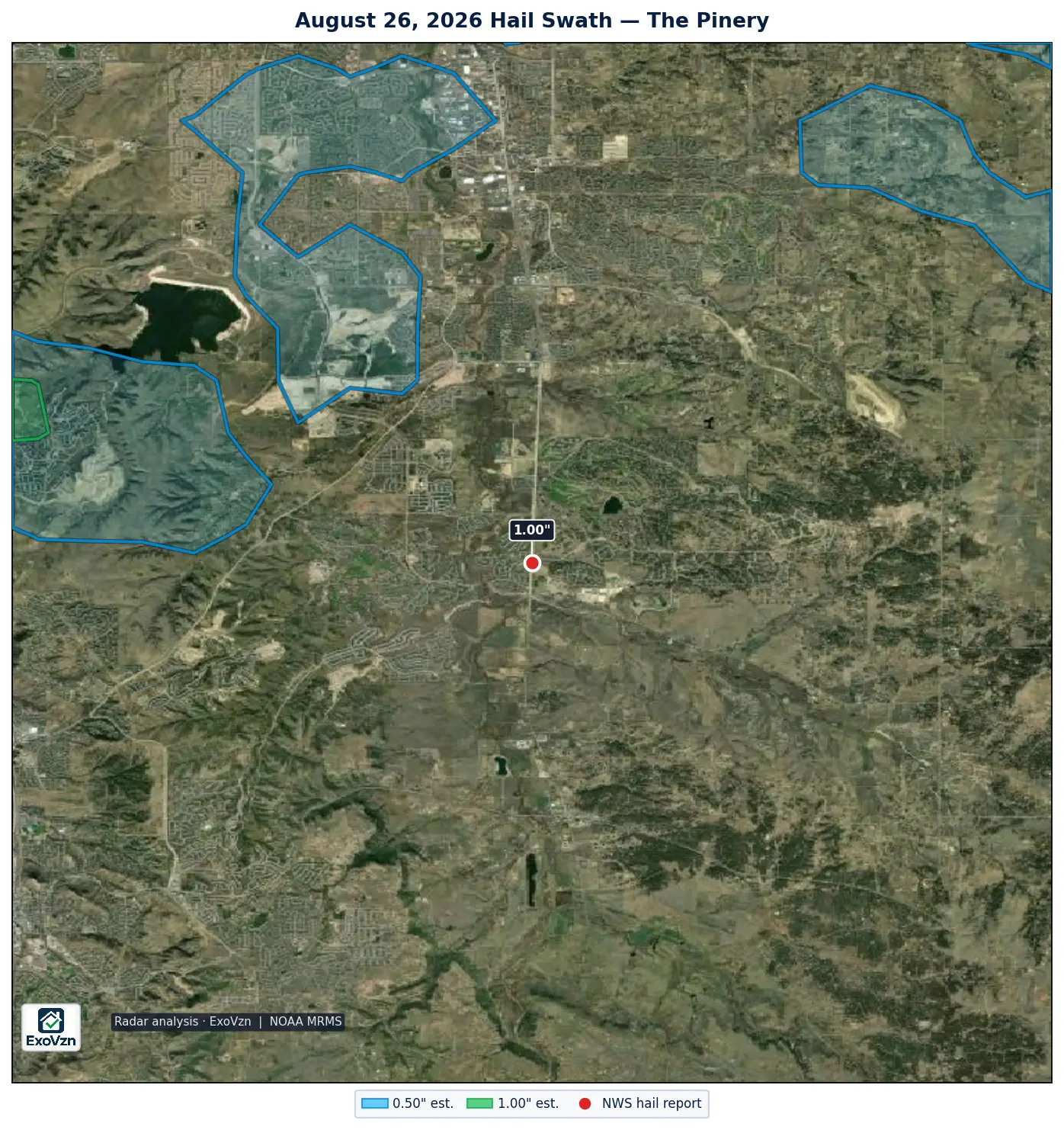
Every hail report in and around Red Hawk’s service area
These are National Weather Service Local Storm Reports — hail an observer found on the ground, not a radar estimate. Times are MDT. “Measured” means the stone was physically measured; “reported” means a size category or description was relayed to the NWS — mPING and public descriptions are not measurements.
| Location | Size | Time | Source | Basis |
|---|---|---|---|---|
| 2 SW The Pinery | 1.00" | 5:20 PM | Public | reported |
The single report in the table is from the The Pinery area. A hail report names the largest stone an observer found, not the average size that fell across every roof in The Pinery.
Was your address in this one? We'll come look, free.
Schedule My Free Inspectionor call (720) 771-8921
What a 1.00-inch hail report tells you about an asphalt roof
A reported hail size is a starting point, not a verdict on any roof. The National Weather Service counts hail of 1 inch or larger as severe (Storm Prediction Center FAQ). A storm report gives the largest stone an observer reported at one spot; it does not say what fell at any particular address.
In storm surveys published by Haag Engineering, damage that affects how a roof sheds water or how long it lasts began at about 1 inch for three-tab asphalt shingles and 1.25 inches for laminated (architectural) shingles, and the lighter, thinner and older products had the lowest thresholds (Marshall, Herzog, Morrison and Smith, 2002). Those are the sizes at which damage began on the roofs surveyed, not sizes at which every roof is damaged; a roof’s age, its condition and what is underneath it all move the number. The largest report in The Pinery was 1.00 inches. That is a report from one spot, not a finding about any roof: only an inspection establishes whether a particular roof was damaged.
Hail damage to asphalt shingles is hard to judge from the ground. In its ice-ball tests Haag Engineering recorded “punctures, tears, or fractures (bruises) in the shingle mats” and granules knocked loose to expose the asphalt underneath (Marshall and others, 2002). Marks like those are found by looking at the shingles up close, which is why a reported hail size is a reason to have a roof inspected, not an answer.
Radar-estimated hail is not measured hail
Radar hail algorithms output a deliberate high-end estimate of what may exist inside a storm cloud, not a measurement of what landed on your roof. Radar estimates characteristically run above what observers actually recover. Treat the shaded swath on the map as the search area and the ground reports as the observations. If a contractor tells you radar showed three-inch hail at your address, ask whether anyone measured it.
Radar did not place The Pinery inside any estimated hail contour for this storm, yet hail was reported on the ground here anyway. The storm’s strongest radar-estimated core nearby reached the 2.50 inch band. Radar estimates and ground reports measure different things, so they routinely disagree; both are shown here rather than the more flattering one.
Radar estimate and ground reports by city — August 26, 2026
The map above is the search area. This table asks two narrower questions for each Red Hawk service-area city: did any NWS ground report come from inside the city’s actual boundary, whatever locality name the NWS filed it under; and did a radar-estimated hail band of 1.00 inch or larger cross that boundary? A ground report is an observation and always lists the city. The band is an MRMS estimate, not a measurement.
| City | Radar estimate | Share of the city under it | Ground reports inside it | Boundary used |
|---|---|---|---|---|
| The Pinery | none | — | 1 report, 1.00″ (reported) | city limits |
On the ground, one National Weather Service hail report came from inside The Pinery city limits: 1.00 inch (reported). Radar placed no estimated hail band of any size over The Pinery. A ground report is an observation; radar output is an estimate, and the two routinely disagree.
City boundaries are the U.S. Census Bureau TIGER/Line 2025 place limits; Denver neighborhoods use the City and County of Denver’s statistical neighborhood polygons. A city is listed if any NWS ground report came from inside that boundary, or if a 1.00 inch or larger radar band crosses it; a ground report is never left off for the size of the radar estimate.
Hail duration, warnings and wind
A Severe Thunderstorm Warning covering The Pinery was issued at 5:00 PM MDT by the National Weather Service. The warning called for hail to 1.00 inch and winds to 60 mph.
What to do if you were under it
- Check from the ground, not the roof. Walking a hail-struck roof is how people get hurt.
- Look in your gutters. Granules collecting in gutters or at downspout outlets are worth photographing.
- Check soft metal. Roof vents, gutters, flashing, the mailbox, AC condenser fins. Dents in soft metal show that hail hit the property; they do not show by themselves that the roof was damaged.
- Photograph what you find with your phone. Phone photos carry a timestamp. Do not edit them.
- Get it inspected. An inspection is the only way to establish whether a roof was damaged.
Frequently asked questions
Was there hail in The Pinery on August 26, 2026?
Yes. The National Weather Service logged 1 hail report in the The Pinery area on August 26, 2026, the largest at 1.00 inches.
How big was the hail in The Pinery?
The largest report was 1.00 inches. Bear in mind a hail report names the biggest stone an observer found, not what fell across the whole city.
What time did the hail hit The Pinery?
Reports came in at 5:20 PM MDT.
Is it too late to check my The Pinery roof from this storm?
No. Hail damage to asphalt shingles, such as a fractured mat or granules knocked loose, is hard to judge from the ground and does not repair itself, so a roof that has not been inspected since the storm is still worth inspecting. Your insurance policy sets its own time limit for reporting a claim; check it.
Does my neighbor's undamaged roof mean mine is fine?
No. Hail swaths are narrow and damage varies street by street. Roof age, shingle type and slope orientation all change the outcome on the same block.
Was there a severe thunderstorm warning in The Pinery on August 26, 2026?
A Severe Thunderstorm Warning covering The Pinery was issued at 5:00 PM MDT by the National Weather Service. The warning called for hail to 1.00 inch and winds to 60 mph. The National Weather Service describes a severe thunderstorm warning as meaning severe weather “has been reported by spotters or indicated by radar.” A warning covers an area; it is not a record of what fell at any address.
Was there a severe thunderstorm warning covering The Pinery on August 26, 2026?
A Severe Thunderstorm Warning covering The Pinery was issued at 5:00 PM MDT by the National Weather Service. The warning called for hail to 1.00 inch and winds to 60 mph. The National Weather Service describes a severe thunderstorm warning as meaning severe weather “has been reported by spotters or indicated by radar.” A warning covers an area; it is not a record of what fell at any address.
Red Hawk tracks every hail day across the Front Range. See our other storm reports for the rest of the 2026 season.
City-by-city reports and hail histories
For the full service-area picture — every report, the radar swath map and the county-wide totals — see our Colorado Hail Storm Report for August 26, 2026.
Not sure what to look for? Start with what hail damage looks like on a roof and the Colorado hail claim guide.
Red Hawk works Colorado roofs year round. We'll still be here next season.
Schedule My Free Inspectionor call (720) 771-8921
Storm figures are National Weather Service Local Storm Reports for Colorado on August 26, 2026 (local time), retrieved from the Iowa Environmental Mesonet archive and de-duplicated. Radar swath analysis by ExoVzn, an independent forensic meteorology firm, using NOAA MRMS data. Damage-threshold figures are from storm surveys published by Haag Engineering (Marshall, Herzog, Morrison and Smith, 2002). Storm reports show where hail was reported; only a physical inspection establishes whether a specific roof was damaged.