

Springfield, Colorado Hail Storm, August 6, 2026: Measured 1.75-Inch Hail in Baca County
August 16, 2026
By Red Hawk Roofing
On the evening of August 6, 2026, a trained spotter measured a 1.75 inch hailstone four miles east-southeast of Springfield, the Baca County seat — golf-ball class, inside a severe thunderstorm warning issued 40 minutes earlier. It was a compact, single-report event, and the measurement is solid.
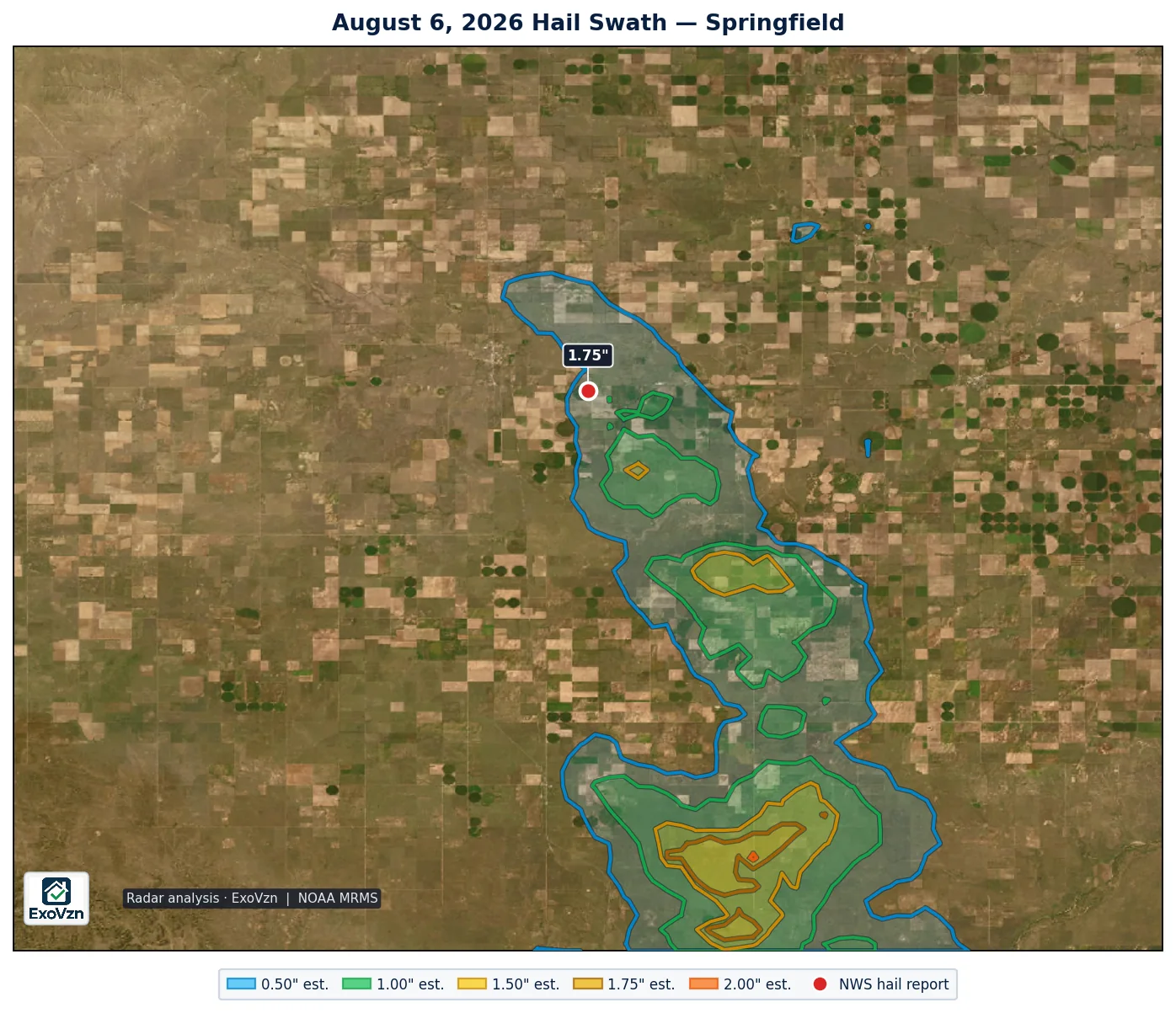
The Springfield hail map — August 6, 2026
The report
This was the only official hail report in Colorado that day. Measured means an observer put a ruler or gauge on the stone. Times are MDT.
| Location | Size | Time | Source | Basis |
|---|---|---|---|---|
| 4 ESE Springfield | 1.75" | 8:12 PM | Trained Spotter | measured |
Radar tells a smaller story than the ruler did. Baca County carried about 107 square miles of radar-estimated 1.00 inch or larger hail that evening, but the strongest estimated contours sat far south near Campo, about 25 miles from Springfield — near the report point itself radar shows only a small estimated 1.50 inch patch, and Springfield sits about six miles outside the estimated 1.00 inch contour. Radar’s estimate near the report ran lower than what the spotter measured — one more reason ground checks beat algorithms in both directions. In a county this empty, one report can also understate a storm: a report only exists where someone found the stones.
Why a measured 1.75-inch stone matters
Impact energy scales hard with stone size. A one-inch stone falls at about 41 mph and lands with roughly 1.3 joules; a 1.75 inch stone falls at about 65 mph and lands with roughly 16 joules — about thirteen times the impact. Published impact studies put the onset of functional damage near 1.00 inch for three-tab asphalt shingles and 1.25 inches for architectural shingles — a measured 1.75 inch stone is past both thresholds. Hail bruising fractures the shingle mat beneath a surface that still looks intact, then sheds granules over the following months, so damage from this storm is only now reaching the point where it shows.
Frequently asked questions
Was there hail in Springfield, Colorado on August 6, 2026?
Yes. A trained spotter measured a 1.75 inch hailstone four miles east-southeast of Springfield at 8:12 PM MDT — golf-ball class, and a genuine measurement, not an estimate. It was the only official hail report in Colorado that day.
Was a warning issued before the Springfield hail?
Yes. A severe thunderstorm warning was issued at 7:32 PM — 40 minutes before the measured report — and further warnings ran until after 10 PM as storms continued over Baca County. A severe thunderstorm watch was issued at 8:07 PM, valid to 11:21 PM.
Did radar show the Springfield hail?
Only partly. Near the report point radar shows a small estimated 1.50 inch patch about two and a half miles away, and Springfield itself sits about six miles outside the estimated 1.00 inch contour — radar ran lower than what the spotter measured. The larger estimated swaths that evening sat near Campo, about 25 miles south. The 1.75 inch measurement is the governing evidence.
Can 1.75 inch hail damage a roof?
Yes. Published impact studies put the onset of functional damage near 1.00 inch for three-tab shingles and 1.25 inches for architectural shingles — a measured 1.75 inch stone is past both. A 1.75 inch stone falls at about 65 mph and lands with roughly 16 joules, about thirteen times the impact energy of a one-inch stone.
Could my roof still have damage from this storm?
Yes. Hail bruising fractures the shingle mat beneath a surface that still looks intact, and the bruised area sheds granules over the following months. An inspection costs nothing and documents the condition either way.
Red Hawk tracks every significant hail day across Colorado. See the 2026 season archive for every covered event. Before any adjuster visit, read what hail damage actually looks like on a roof and the Colorado hail claim guide, or see our hail damage service for what an inspection covers.
Red Hawk works Colorado roofs year round. We'll still be here next season.
Schedule My Free Inspectionor call (720) 771-8921
Storm figures are National Weather Service Local Storm Reports for Colorado on August 6, 2026, retrieved from the Iowa Environmental Mesonet archive; warning times are from the NWS watch/warning archive. Times are MDT and reports are grouped by the local calendar day. Radar swath analysis by ExoVzn, an independent forensic meteorology firm, using NOAA MRMS data. Radar figures are estimates. Storm reports indicate where hail occurred; only a physical inspection establishes whether a specific roof was damaged.