

Colorado Hail Storm Report, May 16, 2026: Hugo
September 11, 2026
By Red Hawk Roofing
Updated September 23, 2026 with complete verified storm reports.
A hail-producing storm crossed Colorado on May 16, 2026. The National Weather Service has logged 1 hail report in this storm’s footprint for that date, the largest at 1.75 inches. Hugo took the most reports.
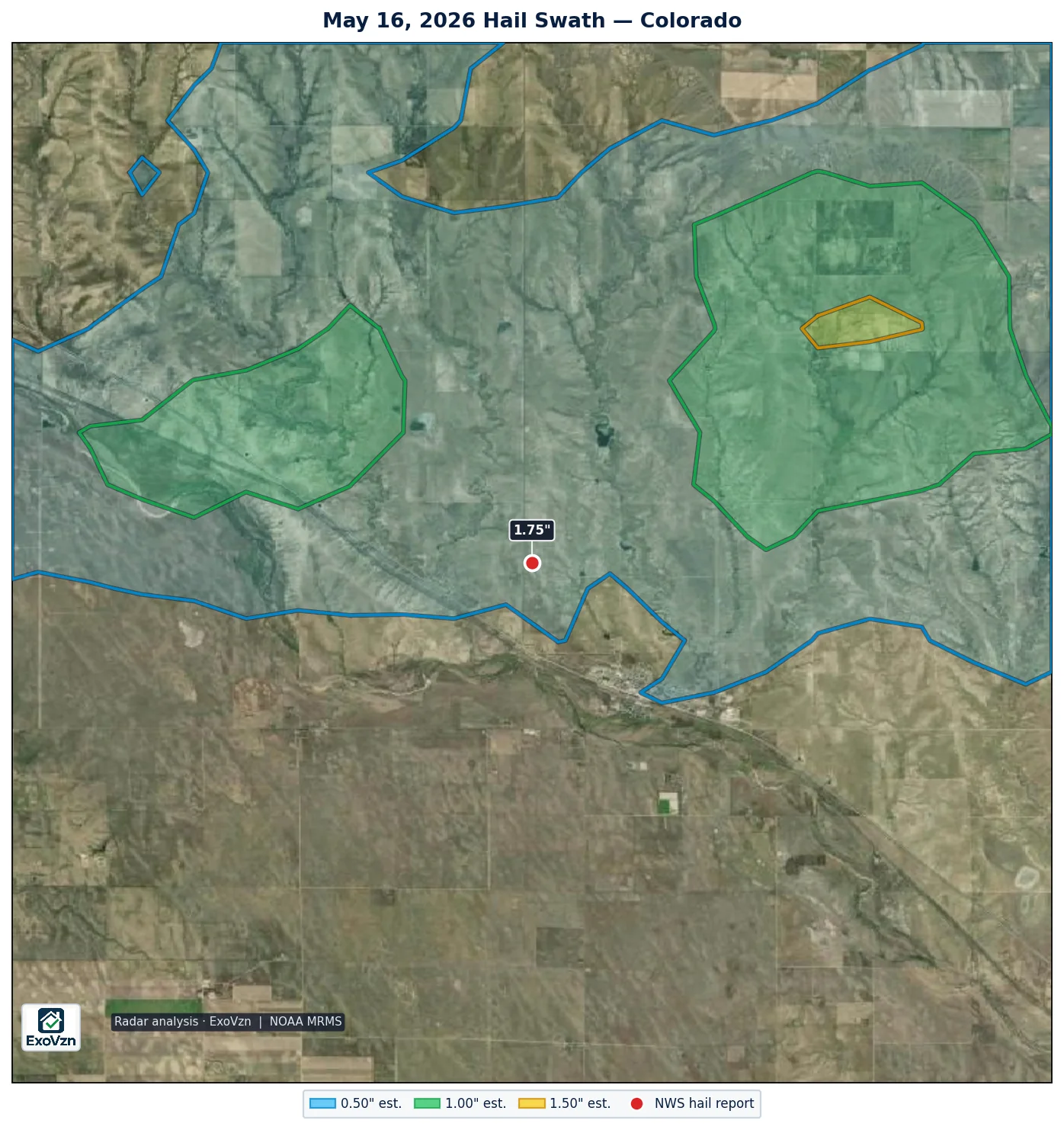
The Colorado hail map — May 16, 2026
Every hail report in Colorado
These are National Weather Service Local Storm Reports — hail an observer found on the ground, not a radar estimate. Times are MDT. “Measured” means the stone was physically measured; “reported” means a size category or description was relayed to the NWS — mPING and public descriptions are not measurements.
| Location | Size | Time | Source | Basis |
|---|---|---|---|---|
| 2 NW Hugo | 1.75" | 3:24 PM | Public | reported |
By city: Hugo 1 report. A hail report always names the largest stone an observer found, not the average size that fell across every roof.
Was your address in this one? We'll come look, free.
Schedule My Free Inspectionor call (720) 771-8921
Why 1.75-inch hail matters to an asphalt roof
Damage scales hard with stone size. A one-inch stone falls at about 41 mph and lands with roughly 1.3 joules of energy. A 1.75 inch stone falls at about 65 mph and lands with roughly 16 joules — about thirteen times the impact. Denver-area elevation adds another 8 to 10 percent to fall speed.
Published impact studies put the onset of functional damage near 1.00 inch for three-tab asphalt shingles, 1.25 inches for architectural shingles, and 2.00 inches for Class 4 impact-rated products. The largest report in Colorado this day was 1.75 inches, past the threshold for architectural shingles.
The damage usually is not visible from the ground. Hail bruises the shingle — fracturing the mat beneath a surface that still looks intact — and the bruised area then sheds its protective granules over the following months. A roof hit in June can look fine all summer and start leaking by winter.
Radar-estimated hail is not measured hail
Radar hail algorithms output a deliberate high-end estimate of what may exist inside a storm cloud, not a measurement of what landed on your roof. Radar estimates characteristically run above what observers actually recover. Treat the shaded swath on the map as the search area and the ground reports as the confirmed observations. If a contractor tells you radar showed three-inch hail at your address, ask whether anyone measured it.
For this storm, MRMS radar estimated hail reaching the 1.50 inch contour band, about 4.1 miles from the nearest ground report. The largest stone anyone actually measured on the ground was 1.75 inches. Radar estimates and ground reports measure different things, so they routinely disagree; both are shown here rather than the more flattering one.
Radar estimate and ground reports by city — May 16, 2026
The map above is the search area. This table asks two narrower questions for each Colorado city in the storm footprint: did any NWS ground report come from inside the city’s actual boundary, whatever locality name the NWS filed it under; and did a radar-estimated hail band of 1.00 inch or larger cross that boundary? A ground report is an observation and always lists the city. The band is an MRMS estimate, not a measurement.
No National Weather Service ground report on this date fell inside a Colorado city boundary, and no 1.00 inch or larger radar band crossed one.
The strongest radar-estimated core of this storm, the 1.50 inch band, crossed no Colorado city. It sits over unincorporated Lincoln County, ZIP code 80821, about 4.4 miles northeast of the Hugo city limit. Named roads under it: County Road 34, County Road 3d, County Road 3c and County Road 35 (roads inside the surrounding 1.00 inch band). The nearest ground report was 4.1 miles away (“2 NW Hugo”, 1.75 inches). No ground observer reported from inside it — reports come from where people happen to be, and their absence is not evidence that nothing fell.
City boundaries are the U.S. Census Bureau TIGER/Line 2025 place limits; Denver neighborhoods use the City and County of Denver’s statistical neighborhood polygons. A city is listed if any NWS ground report came from inside that boundary, or if a 1.00 inch or larger radar band crosses it; a ground report is never left off for the size of the radar estimate. The 0.50 inch band also crossed 9 other Colorado cities with no ground report inside them; those are not listed because hail under one inch rarely damages asphalt shingles and a radar band that small is an estimate below that threshold. A radar contour file covers a whole day statewide. Bands over cities that belong to a DIFFERENT storm on this date are not listed here: a city is only included when it is within 10 miles of this storm’s own reports, or inside the chain of National Weather Service warnings issued on the same cell that produced them.
What to do if you were under it
- Check from the ground, not the roof. Walking a hail-struck roof is how people get hurt.
- Look in your gutters. Granules washing off in quantity is the most common early sign.
- Check soft metal. Roof vents, gutters, flashing, the mailbox, AC condenser fins. Dents in soft metal date the storm.
- Photograph what you find with your phone. Phone photos carry a timestamp. Do not edit them.
- Get it inspected. Especially if this storm was months ago — that is exactly when bruising starts to surface.
Frequently asked questions
Was there hail in Hugo on May 16, 2026?
Yes. The National Weather Service logged 1 hail report in the Hugo area on May 16, 2026. Across Colorado there were 1 reports that day, topping out at 1.75 inches.
How big was the hail on May 16, 2026 in Colorado?
The largest hail reported in Colorado is 1.75 inches. Remember that a hail report names the largest stone found, not what fell across a whole neighborhood.
Which Colorado towns had hail on May 16, 2026?
Reports came in from Hugo.
Could my roof still have damage from this storm?
Yes. Hail bruising fractures the shingle mat beneath a surface that still looks intact, and the bruised area sheds granules over the following months. Damage from a storm earlier in the season is often only becoming visible now, which is exactly why it is worth checking.
How do I check my roof for hail damage?
From the ground, never by climbing up. Look for granules collecting in gutters and at downspout outlets, and dents in soft metal such as roof vents, gutters, flashing, the mailbox and AC condenser fins. Soft-metal dents matter most because they date the storm.
Red Hawk tracks every hail day across the Front Range. See our other storm reports for the rest of the 2026 season.
Not sure what to look for? Start with what hail damage looks like on a roof and the Colorado hail claim guide.
Red Hawk works Colorado roofs year round. We'll still be here next season.
Schedule My Free Inspectionor call (720) 771-8921
Storm figures are National Weather Service Local Storm Reports for Colorado on May 16, 2026 (local time), retrieved from the Iowa Environmental Mesonet archive and de-duplicated. Radar swath analysis by ExoVzn, an independent forensic meteorology firm, using NOAA MRMS data. Impact-energy and damage-threshold figures are from published hail impact research. Storm reports indicate where hail occurred; only a physical inspection establishes whether a specific roof was damaged.