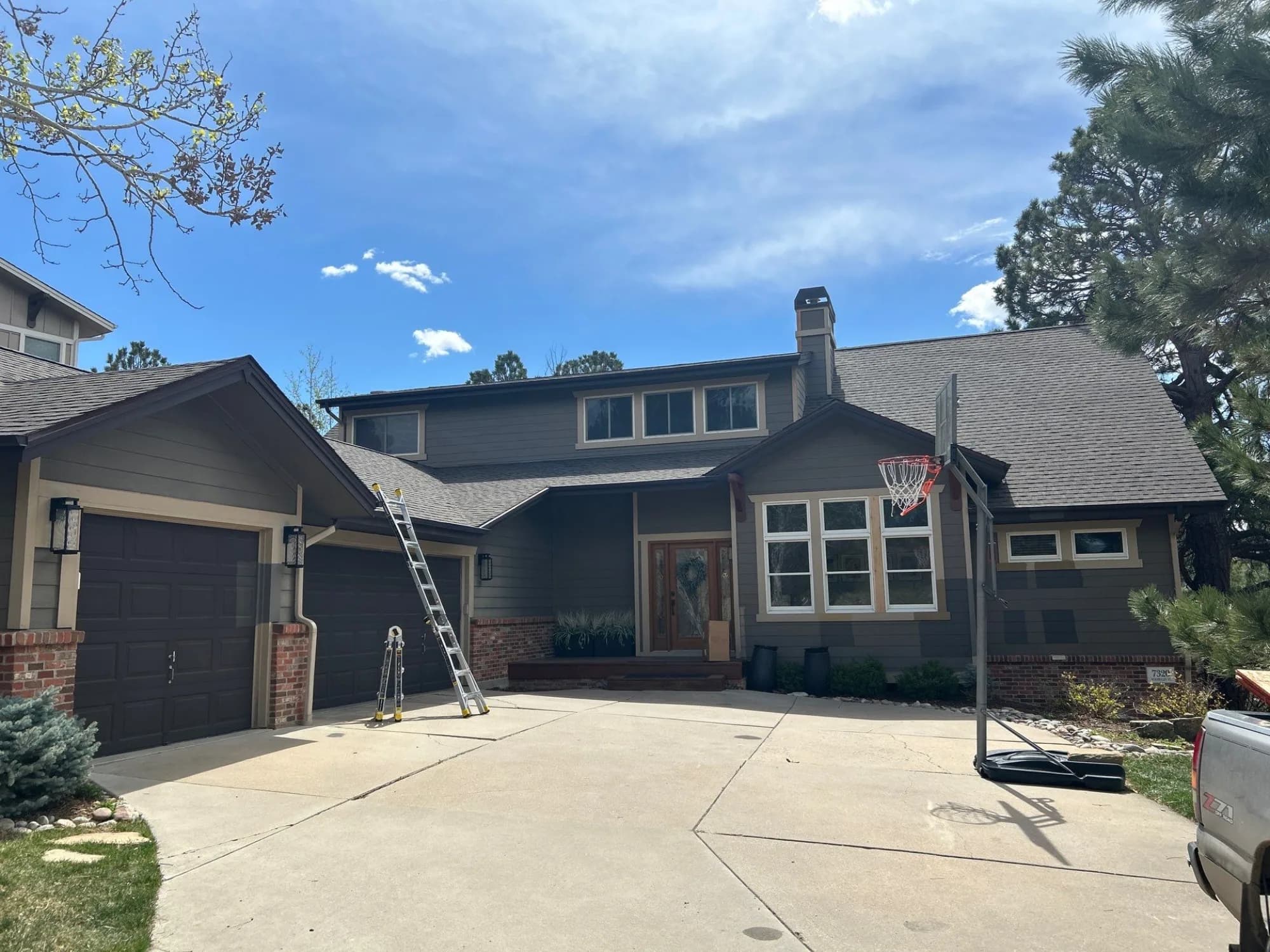
Hail-cracked panes, blown seals from wind events, and aging single-pane windows are common Front Range issues. Red Hawk installs replacement windows from leading manufacturers with hail-rated glass options and full insurance documentation.
Windows in Centennial, Colorado often involves replacing impact-cracked window units after a hail event when the seal is broken or the screen is shredded — frequently rolled into the same insurance claim as the roof. Red Hawk Roofing has documented 5 hail events in Centennial since 2021 — the largest being 1.75-inch hail on August 15, 2026 — which cracks single-pane and stresses double-pane window seals on the windward elevations of the home.
Our Centennial crews also serve Greenwood Village, Aurora South, and Denver — all within our standard Centennial response time. Same crew, same warranty.
Centennial's housing stock is mostly 1980s-2000s subdivisions; many original 25-year asphalt roofs are now at or past their replacement cliff. We work directly with every major Colorado carrier — including State Farm, USAA, Allstate, Farmers, American Family, and Liberty Mutual — and handle the adjuster process end to end on Centennial claims. City of Centennial permits residential roofing through Arapahoe County's process; we handle the application and inspection scheduling.
For windows in Centennial, expect: free roof inspection, adjuster-grade photo documentation, written scope of work, insurance liaison if applicable, and Andersen, Pella, or Milgard replacement units with proper exterior trim, matching interior casing, factory-applied low-E coatings, and full manufacturer warranty. Most windows projects in Centennial complete within 1–3 days depending on opening count and trim complexity.
Hail-rated and impact-resistant glass optionsEnergy-efficient Low-E coatingsInsurance-paid replacements after storm eventsColor-matched frames and trim
Energy Star-rated double-pane windows with Low-E²/Low-E³ coatings and argon gas fill are the standard for Colorado, with U-factor below 0.30 and SHGC (solar heat gain coefficient) tuned to climate zone 5B. Triple-pane with krypton gas pushes U-factor below 0.20 for foothills and high-altitude homes. Look for ENERGY STAR Most Efficient certification, NFRC labels, and warm-edge spacers (not aluminum). Red Hawk installs Andersen, Pella, Marvin, and Milgard with Colorado-spec Low-E coatings tailored to each home's orientation.
Replacement windows in Colorado run $500–$1,200 per window installed for standard double-hung vinyl and fiberglass, $1,000–$2,200 for premium wood-clad and aluminum-clad, and $1,500–$3,500 for impact-rated or large-format custom sizes. Pricing includes window unit, install labor, interior trim restoration, exterior caulking, and disposal. A typical 2,000 sqft Colorado home has 12–18 windows, putting full-home replacement at $9,000–$25,000 for standard, $15,000–$45,000 for premium. Red Hawk provides itemized per-window pricing.
Andersen 100 Series (Fibrex composite frame), Pella Impervia (fiberglass), Marvin Elevate (fiberglass), and Milgard Tuscany are top Colorado choices for durability and hail resistance. Hail-rated glass options (laminated impact glass) are available across all these brands and survive 2-inch hail without breaking. Vinyl windows from major brands handle hail well in the panes but can crack at frame welds in extreme events. Red Hawk recommends fiberglass or composite frames for foothills exposure, vinyl for budget builds.
Centennial asphalt roof replacements typically run $15,000 to $25,000, with most Willow Creek, Walnut Hills, and Foxridge homes landing $15,000–$25,000 for Class 4 impact-resistant installs. Custom homes in The Hills at Cherry Creek and Castlewood with steep pitches and complex valleys run $18,000–$32,000. Centennial's affluent housing stock means more cedar-shake replacements and tile-to-Class 4 conversions than typical metro cities. Red Hawk's Centennial GBP line at (720) 771-8921 provides free written estimates with no high-pressure sales.
Yes — Centennial sits squarely in the Front Range hail track. The ground record shows 5 documented hail days within 10 miles of the city between 2021 and 2026, all confirmed by NWS storm spotters, the largest a 1.75-inch measurement on May 10, 2023 (14 ground reports). Centennial's mature trees provide some shade protection but most roofs still take direct hail strikes during major events. Roofs older than 10 years almost certainly carry cumulative impact damage. Red Hawk pulls NOAA records for every estimate.
Centennial requires a building permit for every tear-off and reroof, issued through the Centennial Building Division (contracted through Safebuilt). Permit fees run $90–$240 depending on roof valuation, with 5–10 business day review. Code requires synthetic underlayment, ice-and-water shield 24 inches inside the heated wall, and proper drip edge. Red Hawk pulls all permits, schedules the post-install inspection, and handles HOA submission packets. Arapahoe County permits unincorporated areas around Centennial separately.
Hail History in Centennial
Centennial has 5 documented hail days within 10 miles of city center between 2021 and 2026 — 5 confirmed by NWS storm-spotter reports on the ground, the largest 1.75-inch hail measured on August 13, 2026 (6 reports), where NOAA radar indicated 3.0 inches — 1.25 inches above the measured size. Radar figures are NOAA SWDI estimates (MEHS), not measurements; ground figures are NWS Local Storm Reports.
Aug 15
2026
1.75"
Measured
1 report
radar 2.25" (+0.50")
LSR+SWDI
Aug 13
2026
1.75"
Measured
6 reports
radar 3.00" (+1.25")
LSR+SWDI
May 30
2024
1.75"
Measured
14 reports
radar 2.50" (+0.75")
LSR+SWDI
Jun 22
2023
1.75"
Measured
11 reports
radar 2.75" (+1.00")
LSR+SWDI
May 10
2023
1.75"
Measured
14 reports
radar 3.00" (+1.25")
LSR+SWDI
Measured figures are NWS Local Storm Reports — human-observed, ground-confirmed hail. Radar-indicated figures are NOAA SWDI estimates (MEHS, a radar algorithm calibrated to a high-end bound) — not measurements, and they can run high versus paired ground reports. Events within ~10 miles of Centennial center, 2021–present, ≥1.0 inch.