From small retail to multi-tenant industrial, Red Hawk Roofing services commercial properties across the Front Range. We work with property managers, owners, and insurance teams.
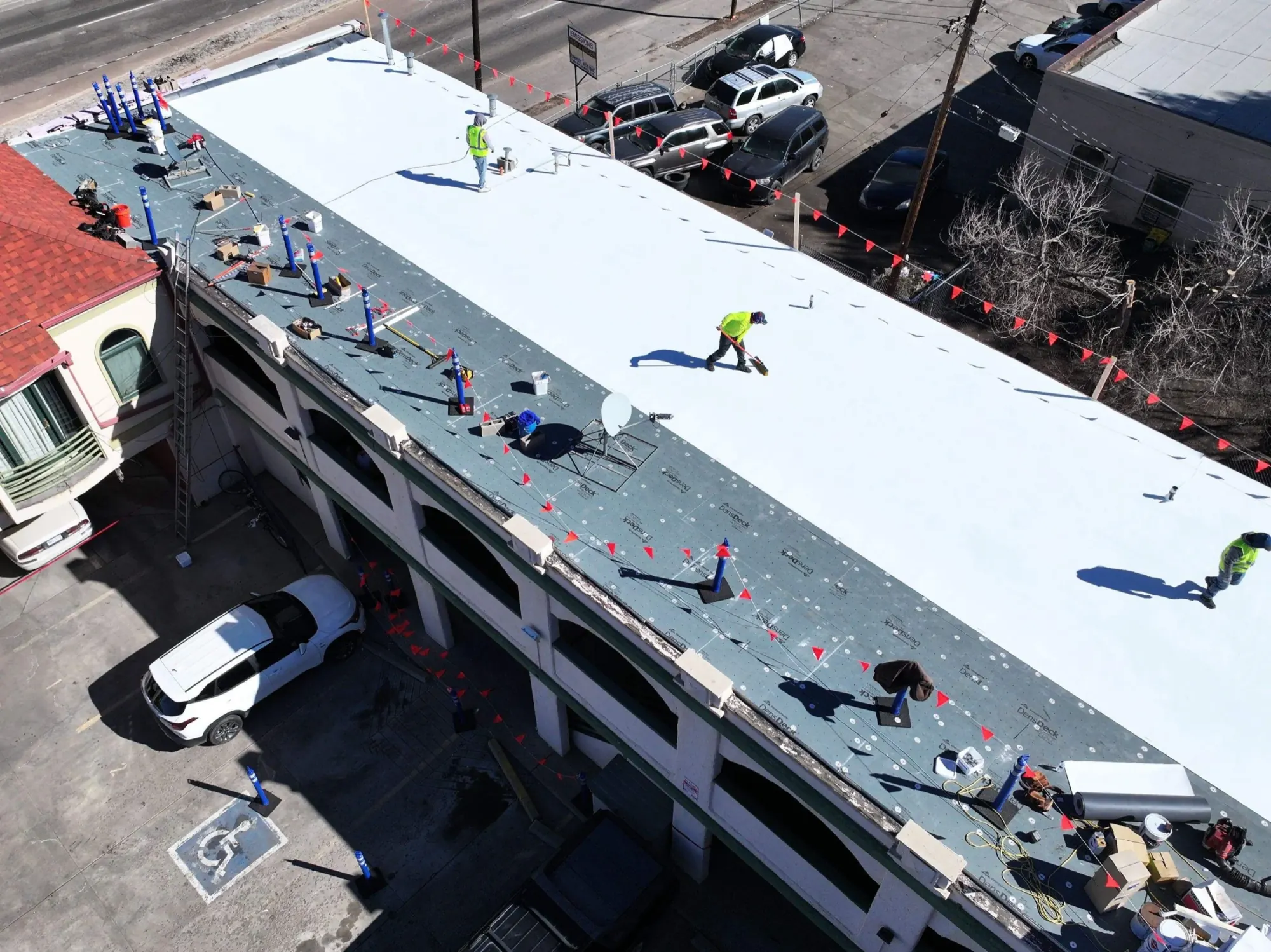
Commercial Roofing in Boulder, Colorado often involves installing or restoring TPO and EPDM membrane systems on flat and low-slope commercial buildings — the dominant assembly for Colorado warehouses, retail, and HOA-common buildings. Red Hawk Roofing has documented 5 hail events in Boulder since 2021 — the largest being 1.00-inch hail on July 11, 2025 — which causes the punctures, tears, and fastener pull-through on aging single-ply membranes we repair or replace under commercial scopes.
Our nearest office to Boulder is in Englewood at 3535 S Platte River Dr # A. We dispatch Englewood-based crews from there for Boulder projects — same crew, same warranty.
Boulder's housing stock is a mix of mid-century ranches and 2000s-2010s infill, with a meaningful slice of historic and high-performance builds that need careful flashing detail. We work directly with every major Colorado carrier — including State Farm, USAA, Allstate, Farmers, American Family, and Liberty Mutual — and handle the adjuster process end to end on Boulder claims. Boulder County's energy-code overlay requires R-value documentation on any deck-level work; we handle the permit, the energy paperwork, and the inspection coordination.
For commercial roofing in Boulder, expect: free roof inspection, adjuster-grade photo documentation, written scope of work, insurance liaison if applicable, and 60-mil TPO or EPDM membrane, mechanically attached or fully adhered per substrate, factory-trained welds, full curb and penetration flashing, and 15–20 year material warranty. Most commercial roofing projects in Boulder complete within 1–3 weeks depending on building size, deck prep, and tenant access.
Red Hawk installs TPO (thermoplastic polyolefin), EPDM rubber, PVC, modified bitumen, built-up roofing (BUR), and standing-seam metal across the Front Range. TPO is the most common new-install in Colorado for its energy efficiency and cool-roof properties; EPDM is durable for low-slope industrial buildings; metal is preferred for distribution and retail. We also handle re-cover systems where a new membrane is installed over existing roofing without tear-off, reducing project timeline and cost by 20–30%.
Commercial roofs are typically low-slope (under 2:12 pitch) with single-ply membrane systems, while residential roofs are steep-slope with shingles or panels. Commercial install requires different specialized equipment (heat welders, hot mops, rolling racks), specific safety planning around HVAC and rooftop equipment, and longer warranty options up to 30 years. Project timelines are longer (1–6 weeks vs 1–3 days), permit and engineering requirements stricter, and ongoing maintenance contracts are standard. Red Hawk's commercial division is staffed separately from residential crews.
Manufacturer membrane warranties on commercial systems typically run 15, 20, or 30 years depending on system selection. NDL (No Dollar Limit) warranties are the gold standard — manufacturer covers all repair costs for the warranty period with no cap. System warranties (membrane + insulation + accessories combined) cost more but cover the entire assembly. Red Hawk's workmanship warranty is 5 years on commercial installs. We help you register your project with the manufacturer (Carlisle, GAF, Firestone, Johns Manville) to activate full coverage.
Boulder roofs frequently cost 10–25% more than comparable Denver-metro homes due to steeper average pitches in foothills neighborhoods, complex architecture in Mapleton Hill and Newlands, stricter green building code requirements, longer permit review cycles, and higher city wage rates. Average Boulder asphalt replacements run $12,000–$30,000, with custom Chautauqua and University Hill homes reaching $40,000+. Red Hawk provides free line-item estimates that separate base roof, code upgrades, and architectural premiums.
Boulder enforces SmartRegs and the Boulder Energy Conservation Code, which often requires above-baseline R-value attic insulation when a roof is opened, cool-roof reflective shingles for low-slope sections, and ENERGY STAR-rated underlayment in some cases. Reroof permits trigger inspection of attic ventilation balance (intake to exhaust ratio of 50/50). Red Hawk handles all code documentation and submits energy compliance paperwork as part of the permit. Plan for $400–$1,200 in code-driven adders on most Boulder reroofs.
Yes — though generally smaller than eastern-plains hail, Boulder has a documented record of 5 hail days within 10 miles of the city between 2021 and 2026, all confirmed by NWS storm spotters. Ground-measured stones here have run to 1.0 inch (July 11, 2025), smaller than Greeley-area hail but still capable of damaging aging shingles, and NOAA radar has indicated larger signatures aloft on those days. Storms that build over the foothills tend to weaken as they reach the higher, closer-in neighborhoods like Chautauqua and Mapleton Hill. Red Hawk pulls NOAA storm records for every estimate.
Hail History in Boulder
Boulder has 5 documented hail days within 10 miles of city center between 2021 and 2026 — 5 confirmed by NWS storm-spotter reports on the ground, the largest 1.0-inch hail measured on July 11, 2025 (1 report), where NOAA radar indicated 2.5 inches — 1.5 inches above the measured size. Radar figures are NOAA SWDI estimates (MEHS), not measurements; ground figures are NWS Local Storm Reports.
Jul 11
2025
1.00"
Measured
1 report
radar 2.50" (+1.50")
LSR+SWDI
Jun 17
2025
1.00"
Measured
1 report
radar 2.25" (+1.25")
LSR+SWDI
May 30
2024
1.00"
Measured
2 reports
radar 2.00" (+1.00")
LSR+SWDI
May 9
2023
1.00"
Measured
1 report
radar 2.25" (+1.25")
LSR+SWDI
Jul 27
2022
1.00"
Measured
1 report
radar 2.50" (+1.50")
LSR+SWDI
Measured figures are NWS Local Storm Reports — human-observed, ground-confirmed hail. Radar-indicated figures are NOAA SWDI estimates (MEHS, a radar algorithm calibrated to a high-end bound) — not measurements, and they can run high versus paired ground reports. Events within ~10 miles of Boulder center, 2021–present, ≥1.0 inch.